
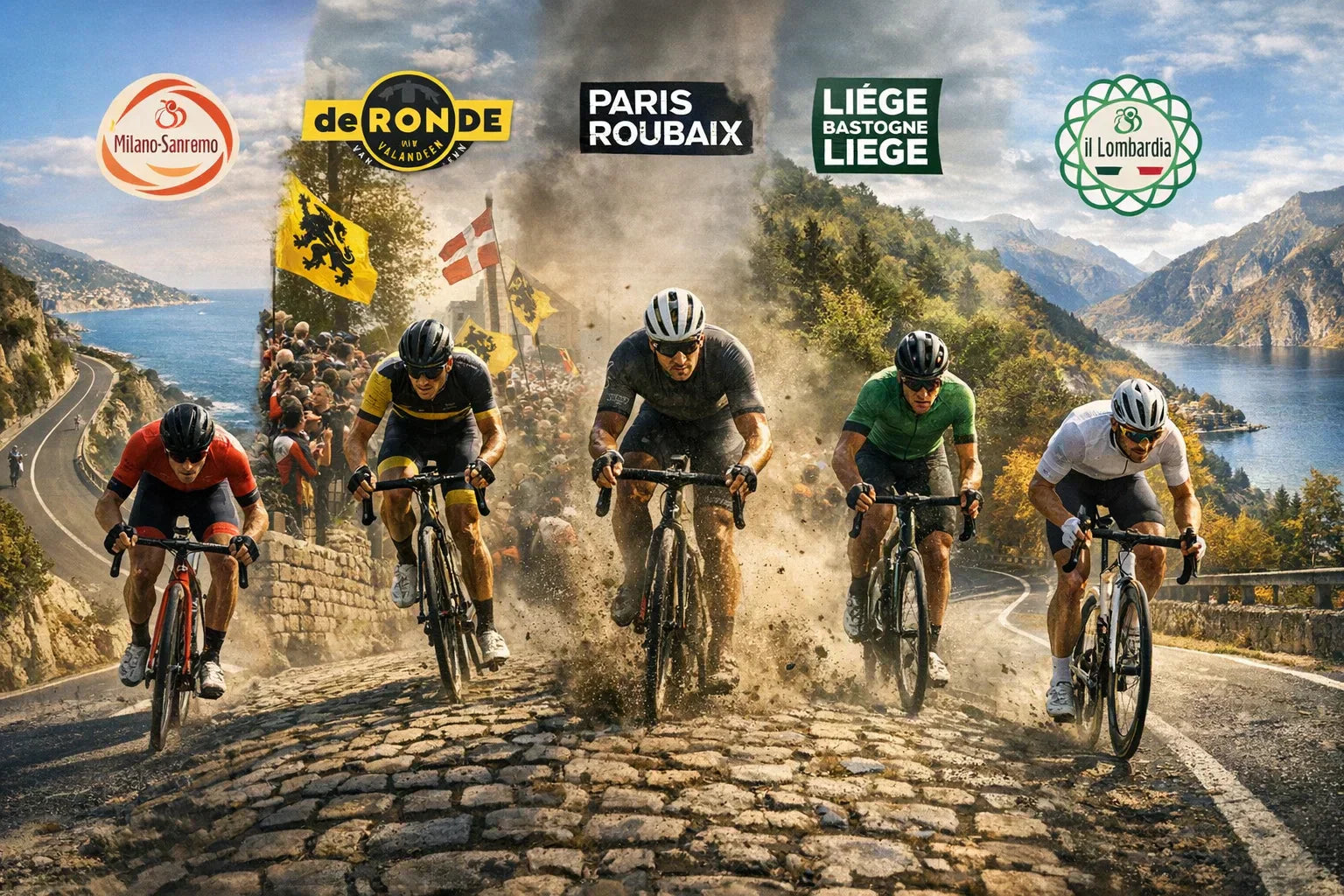
In professional cycling, some races transcend sport to become true legends. They are known as the Monuments. These are the five most prestigious one-day classics on the calendar, the races that forge a career and write a name into history. From Milan-San Remo to Il Lombardia, here is a detailed overview of the 5 Monuments of professional cycling, their distinctive features, their records, their greatest champions and the favourites for the 2026 editions.
Table of contents
The 5 Monuments of professional cycling
Background
The Monuments are the most iconic one-day races in road cycling. Winning one of them often represents the pinnacle of a career, on a par with a rainbow jersey or a Grand Tour victory. Each has a strong identity, a distinctive terrain and a history deeply rooted in European cycling culture.
What is a Monument in cycling?
The five Monuments are:
- Milan-San Remo (March)
- The Tour of Flanders (April)
- Paris-Roubaix (April)
- Liège-Bastogne-Liège (April)
- Il Lombardia (October)
These races are contested over a single day, yet their prestige is immense. They stand apart for their longevity, their difficulty, their historical aura and the calibre of the champions who have won them.
1. Milan-San Remo
Nicknamed La Primavera (the Spring Classic), Milan-San Remo traditionally opens the Monuments season. It is also one of the longest races on the professional calendar, at close to 300 kilometres.
- First edition: 1907
- Country: Italy
- Profile: long race, hilly in the closing kilometres
- Key points: Cipressa, Poggio di San Remo
On paper it looks suited to resilient sprinters. In reality, its tense, tactical finale also gives puncheurs and attackers their chance to shine. Milan-San Remo is renowned for its often unpredictable scenario.
2. Tour of Flanders
The Ronde van Vlaanderen is an institution in Belgium. It is the great celebration of Flemish cycling, carried by a unique wave of public fervour and by its famous cobbled climbs.
- First edition: 1913
- Country: Belgium
- Profile: nervous race with short, steep climbs
- Key points: Oude Kwaremont, Paterberg, Koppenberg
The Tour of Flanders demands power, explosiveness, positioning and stamina all at once. The best classics specialists thrive here thanks to their ability to absorb repeated changes of pace on the cobbled climbs.
3. Paris-Roubaix
Paris-Roubaix is arguably the most legendary of them all. Known as the Hell of the North, it is defined by its often decisive cobbled sectors, its extreme harshness and its merciless character.
- First edition: 1896
- Country: France
- Profile: flat but extraordinarily punishing
- Key points: Trouée d'Arenberg, Mons-en-Pévèle, Carrefour de l'Arbre
Victory here rewards strength as much as endurance, technique and sometimes mechanical luck. Paris-Roubaix is a race apart, capable of breaking legs, bikes and the best-laid strategies.
4. Liège-Bastogne-Liège
The oldest of the five Monuments, Liège-Bastogne-Liège is often called La Doyenne (the Old Lady). It is the classic of climbers and puncheurs, built on endurance and the relentless accumulation of Ardennes climbs.
- First edition: 1892
- Country: Belgium
- Profile: hilly to mountainous
- Key points: Côte de La Redoute, Roche-aux-Faucons
Less chaotic than Paris-Roubaix but every bit as demanding, Liège-Bastogne-Liège often crowns complete riders capable of making the difference on a steep climb after more than 250 kilometres of effort.
5. Il Lombardia
The final Monument of the season, Il Lombardia is nicknamed the Race of the Falling Leaves. Its autumnal atmosphere and rugged course give it a very distinctive identity.
- First edition: 1905
- Country: Italy
- Profile: hilly to mountainous
- Key points: Madonna del Ghisallo, Civiglio, San Fermo della Battaglia
The Il Lombardia course generally favours climbers, puncheurs and aggressive riders. It is a spectacular race, often won by champions who can also excel in the Grand Tours.
| Race | Country | First edition | Profile type | Nickname |
|---|---|---|---|---|
| Milan-San Remo | Italy | 1907 | Long, hilly | La Primavera |
| Tour of Flanders | Belgium | 1913 | Cobbled climbs | De Ronde |
| Paris-Roubaix | France | 1896 | Flat, cobbled, very punishing | The Hell of the North |
| Liège-Bastogne-Liège | Belgium | 1892 | Ardennes, hilly | La Doyenne |
| Il Lombardia | Italy | 1905 | Rugged, mountainous | Race of the Falling Leaves |
The 5 Monuments compared
These five races do not call for the same qualities:
- Milan-San Remo favours fast, tactically astute riders.
- The Tour of Flanders rewards power and the ability to repeat violent efforts.
- Paris-Roubaix demands robustness, technique and extreme resilience.
- Liège-Bastogne-Liège rewards the most enduring climbing puncheurs.
- Il Lombardia often suits aggressive climbers and long-distance specialists.
Winning all five Monuments is an exceedingly rare feat. Few riders in history have managed to triumph across such different terrains.
| Monument | Key qualities | Ideal rider profile |
|---|---|---|
| Milan-San Remo | Endurance, speed, timing | Sprinter-puncheur |
| Tour of Flanders | Power, positioning, explosiveness | Flemish classics specialist |
| Paris-Roubaix | Resilience, technique, composure | Powerful rouleur |
| Liège-Bastogne-Liège | Endurance, punch, climbing | Climbing puncheur |
| Il Lombardia | Climbing ability, attacking, effort management | Aggressive climber |
Top 3 of each Monument in history
The table below lists the most successful riders on each of the five Monuments across the entire history of the race. Where several riders are level, they are shown as tied.
| Race | 1st | 2nd | 3rd |
|---|---|---|---|
| Milan-San Remo | Eddy Merckx 7 wins |
Costante Girardengo 6 wins |
Erik Zabel / Gino Bartali 4 wins |
| Tour of Flanders | Johan Museeuw / Mathieu van der Poel / Fabian Cancellara / Tom Boonen / Tadej Pogačar / Eric Leman / Fiorenzo Magni / Achiel Buysse 3 wins |
Stijn Devolder / Peter Van Petegem / Briek Schotte / Walter Godefroot / Eddy Merckx 2 wins |
Several riders 1 win |
| Paris-Roubaix | Roger De Vlaeminck / Tom Boonen 4 wins |
Francesco Moser / Fabian Cancellara / Mathieu van der Poel / Rik Van Looy / Eddy Merckx / Johan Museeuw / Gaston Rebry / Octave Lapize 3 wins |
Several riders 2 wins |
| Liège-Bastogne-Liège | Eddy Merckx 5 wins |
Tadej Pogačar / Alejandro Valverde / Moreno Argentin 4 wins |
Alfred De Bruyne / Alfons Schepers / Léon Houa 3 wins |
| Il Lombardia | Fausto Coppi / Tadej Pogačar 5 wins |
Alfredo Binda 4 wins |
Damiano Cunego / Sean Kelly / Gino Bartali / Gaetano Belloni / Costante Girardengo / Henri Pélissier 3 wins |
Records by race and the greatest Monument collectors
Beyond recent results, each Monument has its own historical benchmarks. Some records have stood for decades; others have just been equalled or threatened by the current generation.
| Race | Record holder(s) | Number of wins |
|---|---|---|
| Milan-San Remo | Eddy Merckx | 7 |
| Tour of Flanders | Achiel Buysse, Eric Leman, Fiorenzo Magni, Johan Museeuw, Tom Boonen, Fabian Cancellara, Mathieu van der Poel, Tadej Pogačar | 3 |
| Paris-Roubaix | Roger De Vlaeminck, Tom Boonen | 4 |
| Liège-Bastogne-Liège | Eddy Merckx | 5 |
| Il Lombardia | Fausto Coppi, Tadej Pogačar | 5 |
| Rank | Rider | Total Monuments | Different Monuments won |
|---|---|---|---|
| 1 | Eddy Merckx (BEL) | 19 | 5 |
| 2 | Tadej Pogačar (SLO) | 13 | 4 |
| 3 | Roger De Vlaeminck (BEL) | 11 | 5 |
| 4 | Costante Girardengo (ITA) | 9 | 2 |
| 5 | Fausto Coppi (ITA) | 9 | 3 |
| 6 | Sean Kelly (IRL) | 9 | 4 |
| 7 | Rik Van Looy (BEL) | 8 | 5 |
| 8 | Mathieu van der Poel (NED) | 8 | 3 |
| 9 | Gino Bartali (ITA) | 7 | 2 |
| 10 | Tom Boonen (BEL) / Fabian Cancellara (SUI) | 7 | 2 / 3 |
Winners of the 5 Monuments by year since 1980
The table below lists the winners of the five great Monuments since 1980. For 2026, races not yet contested at the time of this update are marked with a dash.
| Year | Milan-San Remo | Tour of Flanders | Paris-Roubaix | Liège-Bastogne-Liège | Il Lombardia |
|---|---|---|---|---|---|
| 2026 | Tadej Pogačar | Tadej Pogačar | Wout van Aert | Tadej Pogačar | — |
| 2025 | Mathieu van der Poel | Tadej Pogačar | Mathieu van der Poel | Tadej Pogačar | Tadej Pogačar |
| 2024 | Jasper Philipsen | Mathieu van der Poel | Mathieu van der Poel | Tadej Pogačar | Tadej Pogačar |
| 2023 | Mathieu van der Poel | Tadej Pogačar | Mathieu van der Poel | Remco Evenepoel | Tadej Pogačar |
| 2022 | Matej Mohorič | Mathieu van der Poel | Dylan van Baarle | Remco Evenepoel | Tadej Pogačar |
| 2021 | Jasper Stuyven | Kasper Asgreen | Sonny Colbrelli | Tadej Pogačar | Tadej Pogačar |
| 2020 | Wout van Aert | Mathieu van der Poel | Cancelled | Primož Roglič | Jakob Fuglsang |
| 2019 | Julian Alaphilippe | Alberto Bettiol | Philippe Gilbert | Jakob Fuglsang | Bauke Mollema |
| 2018 | Vincenzo Nibali | Niki Terpstra | Peter Sagan | Bob Jungels | Thibaut Pinot |
| 2017 | Michał Kwiatkowski | Philippe Gilbert | Greg Van Avermaet | Alejandro Valverde | Vincenzo Nibali |
| 2016 | Arnaud Démare | Peter Sagan | Mathew Hayman | Wout Poels | Esteban Chaves |
| 2015 | John Degenkolb | Alexander Kristoff | John Degenkolb | Alejandro Valverde | Vincenzo Nibali |
| 2014 | Alexander Kristoff | Fabian Cancellara | Niki Terpstra | Simon Gerrans | Dan Martin |
| 2013 | Gerald Ciolek | Fabian Cancellara | Fabian Cancellara | Dan Martin | Joaquim Rodríguez |
| 2012 | Simon Gerrans | Tom Boonen | Tom Boonen | Maxim Iglinskiy | Joaquim Rodríguez |
| 2011 | Matthew Goss | Nick Nuyens | Johan Vansummeren | Philippe Gilbert | Oliver Zaugg |
| 2010 | Óscar Freire | Fabian Cancellara | Fabian Cancellara | Alexandr Vinokourov | Philippe Gilbert |
| 2009 | Mark Cavendish | Stijn Devolder | Tom Boonen | Andy Schleck | Philippe Gilbert |
| 2008 | Fabian Cancellara | Stijn Devolder | Fabian Cancellara | Alejandro Valverde | Damiano Cunego |
| 2007 | Óscar Freire | Alessandro Ballan | Stuart O'Grady | Danilo Di Luca | Damiano Cunego |
| 2006 | Filippo Pozzato | Tom Boonen | Tom Boonen | Alejandro Valverde | Paolo Bettini |
| 2005 | Alessandro Petacchi | Tom Boonen | Tom Boonen | Alexandr Vinokourov | Paolo Bettini |
| 2004 | Óscar Freire | Steffen Wesemann | Magnus Bäckstedt | Davide Rebellin | Damiano Cunego |
| 2003 | Paolo Bettini | Peter Van Petegem | Peter Van Petegem | Tyler Hamilton | Michele Bartoli |
| 2002 | Mario Cipollini | Andrea Tafi | Johan Museeuw | Paolo Bettini | Michele Bartoli |
| 2001 | Erik Zabel | Gianluca Bortolami | Servais Knaven | Oscar Camenzind | Danilo Di Luca |
| 2000 | Erik Zabel | Andrei Tchmil | Johan Museeuw | Paolo Bettini | Raimondas Rumšas |
| 1999 | Andrei Tchmil | Peter Van Petegem | Andrea Tafi | Frank Vandenbroucke | Mirko Celestino |
| 1998 | Erik Zabel | Johan Museeuw | Franco Ballerini | Michele Bartoli | Oscar Camenzind |
| 1997 | Erik Zabel | Rolf Sørensen | Frédéric Guesdon | Michele Bartoli | Laurent Jalabert |
| 1996 | Gabriele Colombo | Michele Bartoli | Johan Museeuw | Pascal Richard | Andrea Tafi |
| 1995 | Laurent Jalabert | Johan Museeuw | Franco Ballerini | Mauro Gianetti | Gianni Faresin |
| 1994 | Giorgio Furlan | Gianni Bugno | Andrei Tchmil | Evgeni Berzin | Vladislav Bobrik |
| 1993 | Maurizio Fondriest | Johan Museeuw | Gilbert Duclos-Lassalle | Rolf Sørensen | Pascal Richard |
| 1992 | Sean Kelly | Jacky Durand | Gilbert Duclos-Lassalle | Dirk De Wolf | Tony Rominger |
| 1991 | Claudio Chiappucci | Edwig Van Hooydonck | Marc Madiot | Moreno Argentin | Sean Kelly |
| 1990 | Gianni Bugno | Moreno Argentin | Eddy Planckaert | Eric Van Lancker | Gilles Delion |
| 1989 | Laurent Fignon | Edwig Van Hooydonck | Jean-Marie Wampers | Sean Kelly | Tony Rominger |
| 1988 | Laurent Fignon | Eddy Planckaert | Dirk Demol | Adrie van der Poel | Charly Mottet |
| 1987 | Erich Mächler | Claude Criquielion | Eric Vanderaerden | Moreno Argentin | Moreno Argentin |
| 1986 | Sean Kelly | Adrie van der Poel | Sean Kelly | Moreno Argentin | Gianbattista Baronchelli |
| 1985 | Hennie Kuiper | Eric Vanderaerden | Marc Madiot | Moreno Argentin | Sean Kelly |
| 1984 | Francesco Moser | Johan Lammerts | Sean Kelly | Sean Kelly | Bernard Hinault |
| 1983 | Giuseppe Saronni | Jan Raas | Hennie Kuiper | Steven Rooks | Sean Kelly |
| 1982 | Marc Gomez | René Martens | Jan Raas | Silvano Contini | Giuseppe Saronni |
| 1981 | Fons De Wolf | Hennie Kuiper | Bernard Hinault | Josef Fuchs | Hennie Kuiper |
| 1980 | Pierino Gavazzi | Michel Pollentier | Francesco Moser | Bernard Hinault | Fons De Wolf |
Season review and 2026 Monument favourites
At the close of the spring classics, Tadej Pogačar has utterly dominated the Monuments season. The Slovenian won, one after another, Milan-San Remo (his first victory in La Primavera), the Tour of Flanders and Liège-Bastogne-Liège, where he beat the young Frenchman Paul Seixas and Remco Evenepoel on 26 April. Only Paris-Roubaix eluded him, with Wout van Aert winning the Hell of the North ahead of a Pogačar once again beaten on the cobbles. With these three successes, the world champion now has 13 Monuments to his name and is methodically closing in on Eddy Merckx's all-time record (19).
The autumn highlight remains Il Lombardia, scheduled for October. Pogačar, already a five-time consecutive winner and co-holder of the record with Fausto Coppi, will be the overwhelming favourite for a possible 6th victory that would make him the outright record holder of the Race of the Falling Leaves. His main designated rivals are Remco Evenepoel, who will build form after the Grand Tours, along with aggressive climbers such as Paul Seixas, Juan Ayuso and Isaac del Toro, who could capitalise on any off-day from the Slovenian.
Last updated: 1 June 2026
Conclusion
The 5 Monuments of professional cycling are the jewels of the classics calendar. Each tells a different story: the length of Milan-San Remo, the climbs of the Tour of Flanders, the cobbles of Paris-Roubaix, the hills of Liège-Bastogne-Liège and the autumnal elegance of Il Lombardia.
For riders, winning a Monument means stepping into another dimension. For fans, they are unmissable occasions, steeped in tradition, drama and feats of endurance.
In short, to understand the Monuments is to understand an essential part of the soul of cycling.




Share: